“My Child Is Not Bad… Then, Why This Behaviour?”
It usually starts with something small.
Your child refuses to wear shoes when you are already late.
Throws a tantrum in the market.
Talks back when you ask them to finish homework.
And before you know it, a thought crosses your mind:
“Why is my child becoming so stubborn?”
Most Indian parents care deeply for their children, but still feel confused and helpless when these situations keep happening.
Many of us were taught that good children always listen and that misbehaviour should be corrected strictly.
So when our child acts out, we often feel both guilty and frustrated.
Let’s take a moment to gently remind ourselves:
👉 Your child is not bad.
👉 Your child is not spoiled.
👉 Your child is trying to communicate something they don’t yet know how to say.
This guide is for parents of toddlers, preschoolers, and school-age children who feel confused, guilty, or overwhelmed by daily behaviour challenges.
Table of Contents
What We Call “Misbehaviour” Is Often a Message
We often think misbehaviour means disobedience, but they are not the same.
Adults have learned to say things like, “I had a rough day, can you give me some space?”
But Children can not express themselves like adults.
Children do not misbehave because they enjoy troubling their parents.
They misbehave because their emotions are bigger than their words.
A child’s brain is still growing. The part that manages emotions develops faster than the parts that control impulses or understand logic.
So when emotions get too big, their behaviour shows it.
Crying, shouting, throwing things, or refusing to listen are not signs of a “bad child.”
There are signs that a child doesn’t yet know how to cope.
Misbehaviour is often a message saying:
- “I need your attention.”
- “I am overwhelmed.”
- “I don’t know how to handle this feeling.”
- “I feel disconnected.”
The Real Reasons Children Misbehave
If we dig beneath the surface, we usually find one of these seven causes driving the chaos.
1. Unmet Emotional Needs
Every child has an “emotional bucket.” When it’s full of connection and love, they cooperate. When it’s empty, they act out. Children often think in simple terms: “Negative attention is better than no attention.”
Children need emotional connection just like they need food.
In busy Indian homes, parents juggle work, family, elders, and many responsibilities. Children often get instructions but not much undivided attention.
When a child feels emotionally unseen, they may:
• Act out
• Interrupt constantly
• Misbehave more around parents than others
A child would rather be scolded than ignored.
2. Overwhelming Emotions They Can’t Handle Yet
This is about biology, not drama. A child’s brain is still developing.
The emotional part of the brain (the Amygdala) is fully active, but the logical part (the Prefrontal Cortex) is under construction.
When a child has a meltdown because their toast is cut the wrong way, it’s not really about the toast.
It’s an emotional overload.
They are overwhelmed by big feelings in a small body and truly cannot calm down without help.
3. Lack of Skills, Not Lack of Manners
We often assume children know better.
But skills like patience, sharing, waiting, losing a game, or following instructions are learned over time. They don’t come automatically.
A child who:
• Can’t wait for their turn
• Gets angry when they lose
• Refuses to share
is not ill-mannered.
They are still learning self-control.
Punishment does not teach skills.
Guidance does.
For example, when a child grabs a toy from a sibling, it doesn’t mean they are “greedy.” They may not have learned to wait or to ask for a turn. They are misbehaving because they don’t yet know what to do in that moment.
4. Hunger, Sleep Deprivation, and Screen Overload
Sometimes the reason is straightforward.
A hungry child cannot cooperate.
A tired child cannot control emotions.
An overstimulated child cannot calm down.
Too much screen time can overstimulate the nervous system, making children irritable, restless, and more emotional.
Before correcting behaviour, ask yourself:
• Is my child tired?
• Have they appropriately eaten?
• Are routines irregular?
Many meltdowns go away with enough rest, food, and routine.
5. Need for Autonomy and Control
Hearing the word “No” from your toddler is actually a developmental milestone.
It means they are realising they are a separate person from you.
Toddlers and preschoolers have very little control over their lives. Adults decide what they eat, wear, and do.
When children resist instructions, they are often just trying to feel some power or control over their own bodies.
When children say “NO,” they are not being disrespectful.
They are discovering their identity.
Toddlers and preschoolers want independence:
• “I will do it myself.”
• “I don’t want this.”
• “You can’t tell me.”
This is not disobedience; it is part of growing up.
Power struggles increase misbehaviour.
Respectful choices reduce it.
6. Stress in the Environment
Children absorb stress silently.
Family tension, frequent arguments, academic pressure, comparison, or even moving homes can affect behaviour.
Children may not express stress verbally, but it appears as:
• Irritability
• Regression (bedwetting, clinginess)
• Sudden behaviour changes
Misbehaviour is often stress speaking through a child.
7. Children Copy What They See
Children learn more from what we do than what we say.
If adults:
• Shout when angry
• Use phones constantly
• React impatiently
Children absorb the same patterns.
This isn’t about blame; it’s about awareness.
Children are mirrors.
It can be hard to accept, but children copy what they see, not what they are told.
Common Parenting Myths That Make Misbehaviour Worse
• “Strict discipline will fix it”: Fear-based parenting (shouting/hitting) might stop the behaviour instantly, but it breaks the trust. It teaches the child to hide their behaviour rather than improve it.
• “If I ignore the emotion, the behaviour will stop”: Ignoring a distressed child usually makes them scream louder to be heard. You can give them some time – it actually helps – but don’t ignore it for too long.
• “My child is doing this on purpose”: Very rarely is a child plotting against you. They are usually just struggling to cope.
What Actually Helps When a Child Misbehaves
So, how do we handle the chaos? Here is a roadmap.
Connect Before You Correct
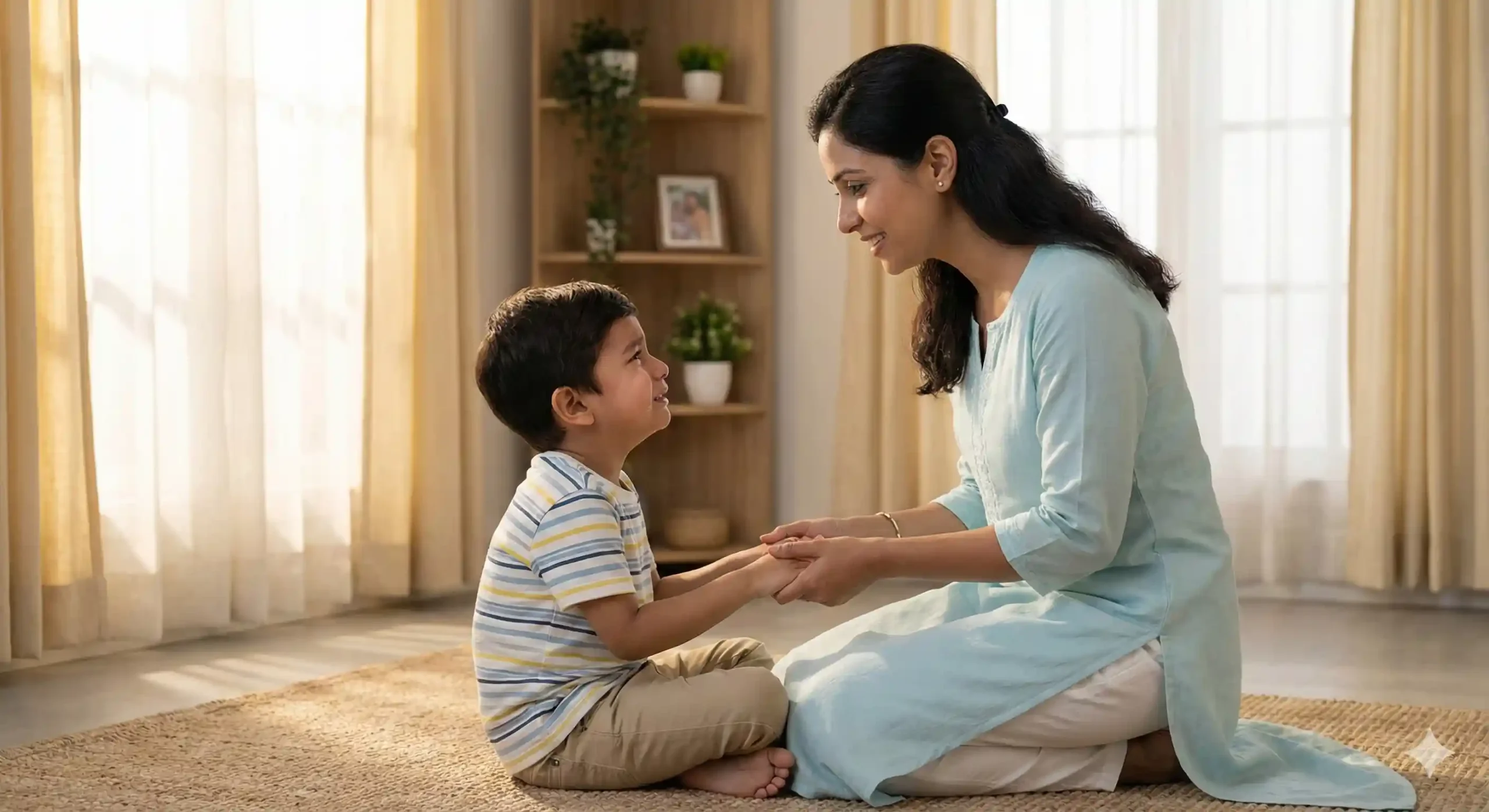
You cannot reason with a child who is in “fight or flight” mode. First, create emotional safety.
• Get down to their eye level.
• Use a calm, low tone.
• Offer physical touch (a hug or a hand on the shoulder).
• Script: “I can see you are very upset. I am here with you.”
Name the Feeling, Not the Fault
Labelling the emotion helps “tame” it. It builds emotional intelligence.
• Instead of: “Stop being so rude!”
• Try: “You sound very angry because you wanted to play longer.” When a child feels understood, the need to “act out” the feeling diminishes.
Teach the Skill Missing in That Moment
Do this after the storm has passed and everyone is calm. Misbehaviour is a teaching opportunity.
• If they hit because they wanted a turn, role-play how to ask for a turn next time.
• Practice the skill when they are happy, so they can use it when they are mad.
Set Firm but Kind Boundaries
Gentle parenting doesn’t mean letting everything go. You can be kind and still set limits.
• The formula: Validate feelings + Hold the limit.
• Script: “I know you want ice cream. It looks delicious. But we don’t eat sugar before bed. We can have fruit instead.”
Age-Wise Misbehaviour: What Is Normal?
One of the most common questions parents ask is:
“Is this behaviour normal for my child’s age?”
Knowing what behaviour is normal for each age helps prevent unnecessary worry or overreaction.
Toddlers (1–3 Years): Big Feelings, Tiny Control
This stage is marked by exploration and emotional overflow.
You may notice:
• Frequent tantrums
• Throwing objects
• Biting or hitting
• Strong resistance to instructions
Toddlers can’t yet control their emotions. Tantrums aren’t manipulation; they show that their nervous system is still developing.
What helps most:
• Staying calm and close
• Predictable routines
• Simple emotion words
• Gentle redirection
This phase is temporary and developmentally normal.
Preschoolers (3–6 Years): “I Want to Do It My Way”
Preschoolers are learning independence and identity.
Common behaviours include:
• Defiance and negotiation
• Testing boundaries repeatedly
• Emotional outbursts
• Occasional lying or exaggeration
They are not being disrespectful; they are learning where the limits are.
What helps most:
• Consistent boundaries
• Limited choices
• Calm explanations
• Encouragement for effort
School-Age Children: Emotions Under Pressure
As children grow, misbehaviour becomes more subtle but emotionally driven.
You may see:
• Back-talk or attitude
• Avoidance of responsibilities
• Emotional shutdown or irritability
Academic pressure, peer influence, and fear of failure are big stressors, especially in Indian families.
What helps most:
• Emotional check-ins, not only academic ones
• Safe conversations without judgment
• Reassurance that love is not linked to performance
When Should Parents Be Concerned? (The Red Flags)
While 90% of what we see is everyday developmental chaos, there are times when you should pause and dig deeper.
Intensity and Duration
• Normal: A 10-minute crying spell because they can’t watch TV.
• Red Flag: Tantrums that last for 30+ minutes, occur multiple times a day, and leave both the child and parent completely exhausted and unable to recover quickly. If they are inconsolable despite your best efforts to calm them, take note.
Harmful Behaviour
• Normal: Occasionally pushing a sibling during a fight.
• Red Flag: Behaviour that is consistently aggressive or dangerous. This includes intentionally hurting themselves (head-banging past toddlerhood, scratching themselves), hurting others with intent, or cruelty to animals.
Sudden Regression
• Normal: A child wanting to be fed like a baby for a day when they are sick or tired.
• Red Flag: A sustained loss of previously mastered skills. For example, a fully potty-trained 5-year-old suddenly wetting the bed every night for weeks, or a talkative child suddenly becoming silent and withdrawn. This often indicates a deeper stressor, trauma, or anxiety that they cannot verbalise.
Note: Getting help from a child psychologist or developmental paediatrician is not a sign of failure. It’s a positive step to help your child thrive.
A Gentle Reminder for Parents
If you take only one thing away from this article, let it be this quote:
“Your child is not giving you a hard time. Your child is having a hard time.”
Parenting isn’t about controlling every move your child makes. It’s about building a connection. When we focus on understanding what our child needs rather than just stopping the behaviour, things often improve.
Conclusion: Behaviour Improves When Understanding Grows
The next time your child acts out, take a deep breath. Pause. Ask yourself: “What is my child trying to tell me?”
It takes patience, and you won’t get it right every time—and that’s okay. These small changes in how you see things can help your child feel secure in the long run.
Little moments, strong bonds.
FAQs or Frequently Asked Questions
Why do children misbehave even with loving parents?
Children don’t misbehave because of bad parenting. Their emotions develop faster than their ability to control impulses or explain their feelings. Misbehaviour often means a child has unmet needs, feels overwhelmed, is stressed or tired, or lacks certain skills.
Is child misbehaviour normal at different ages?
Yes, misbehaviour is normal and changes as children grow. Toddlers have tantrums because they can’t control their emotions well. Preschoolers test limits as they become more independent. School-age children may act out due to school or social stress.
Are tantrums a sign of bad behaviour or manipulation?
No, tantrums are not a way to manipulate. They happen when a child feels overwhelmed and hasn’t learned how to calm down yet. Tantrums show that a child’s nervous system is still developing, not that they mean to misbehave.
Q: How should parents respond when a child misbehaves?
Parents should connect with their child before correcting behaviour. Staying calm, recognizing the child’s feelings, and making them feel safe helps the child calm down. It’s best to teach new skills after the child is calm.
Does strict discipline stop misbehaviour?
Strict or fear-based discipline might stop misbehaviour for a short time, but it doesn’t teach emotional skills. It can harm trust and lead children to hide their actions rather than change them. Guiding and connecting with your child becomes more effective over time.
When should parents be concerned about their child’s behaviour?
Parents should seek help if a child’s behaviour is extreme, lasts a long time, is harmful, or causes issues such as bedwetting or pulling away from others. If behaviour affects sleep, school, or relationships, a professional can offer support.
Is seeing a child psychologist a sign of parenting failure?
No, seeing a child psychologist is not a sign of failure. Asking for help is a positive and responsible choice. It means parents want to understand their child and support their healthy emotional growth.